Integrated Crop-livestock Systems, Climate Change, Soil Health, and Crop Insurance: How Are They Linked?
This project centers around evaluating the economic and soil health impacts of integrated-crop livestock systems. In particular, we aim to understand how integrating crops and livestock on the same land can potentially improve soil health and decrease income uncertainty in volatile market conditions. We further hope to use the template we develop in this project to inform enterprise budget scenarios across Florida and Brazil.
Technical approach
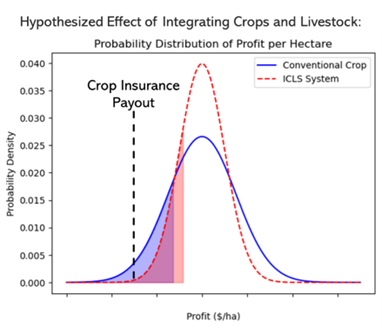
Utilizing Monte Carlo simulations for stochastic enterprise budget scenarios, we are modelling how integration of grazing winter forages supports profitability in peanut-cotton systems. This simulations use a combination of regional and national datasets to determine probability distributions of profit under our contrasting systems and assess risk, particularly in years of poor crop performance. We plan to further simulate these systems under biophysical conditions to understand how integrated crop-livestock systems may support more sustainable and less volatile enterprises.
Expected outcomes
Economic models and probability distributions of profit under conventional and integrated crop-livestock systems
Recommendations for improved risk assessment in integrated crop-livestock systems, particularly in support of improved index-based crop insurance models
Comprehensive meta-analysis of the reported economic outcomes of integrating crops and grazing livestock in global systems
Impact
By quantifying the potential profit stabilization of these integrated systems, we may improve risk assessment and planning, particularly in the crop insurance industry. Moreover, we aim to utilize this enterprise budget approach to inform farmer decision-making and model complex financial scenarios.